 Same-Day
Detection & Repair
- Electronic leak detection (Bacharach H-10G class)
- UV dye injection with follow-up
- Soap-bubble joint verification
- Brazing, valve, and coil repair
- Evacuation to 500 microns + weighed recharge
R-410A · R-32 · R-454B · Legacy R-22
If your AC keeps running low on refrigerant, you have a leak — not a system that 'uses up' freon. We locate the leak with three detection methods, repair it, and weigh in the exact factory charge.
Refrigerant is a closed-loop fluid — your AC doesn't consume it, the way an engine consumes oil. If the system is low, there's a leak somewhere in the line set, evaporator coil, condenser coil, or a valve fitting. EPA Section 608 makes it illegal to add refrigerant to a system known to be leaking without making a reasonable effort to repair the leak first. Every reputable HVAC company in Riverside and San Bernardino County follows that rule.
We detect leaks using three methods in combination: an electronic refrigerant leak detector that picks up parts-per-million in the air around joints, UV dye injection with a follow-up UV lamp inspection a few days later (catches slow leaks the electronic probe misses), and soap-bubble verification at suspect fittings. Most leaks are isolated within 60 minutes. We then repair the leak — brazing copper, replacing a Schrader core, swapping a coil — evacuate the system to remove moisture, and weigh in the exact factory charge to manufacturer spec.
Common refrigerants we handle: R-410A (most 2010–2024 systems), R-32 and R-454B (current low-GWP refrigerants on new installs), and legacy R-22 where parts and supply still allow honest repair. If you've been told your system needs annual refrigerant top-offs, you've been overpaying — call us for a proper AC repair diagnostic.
Warm Air From Vents
System runs constantly, supply vents push lukewarm air. Pressure drop from leak means less heat absorption.
Ice On Copper Line Set
Frozen suction line at the outdoor unit or evaporator coil — classic low-charge symptom.
Hissing Or Bubbling Sound
A faint hiss near the indoor coil or line-set means refrigerant is escaping under pressure.
AC Runs Constantly
System never reaches setpoint because it can't move enough heat. Compressor runtime spikes 30–60%.
More Indoor Humidity
Lower refrigerant = less dehumidification. House feels sticky even when temp is close to setpoint.
Frequent Top-Offs
If a tech has refilled refrigerant more than once, you don't have a 'normal loss' — you have an unrepaired leak.
High Electric Bills
A leaking system overworks the compressor. Summer bills can jump 25–40% before the system fails outright.
UV Dye Glowing At Joint
Yellow-green stain at a coil joint or line-set fitting under UV light = confirmed leak location.
Same-DayDetection & Repair
 When It Matters
Emergency Recharge
Residential and light-commercial — splits, package units, heat pumps, and ductless.
R-410A (Puron)
The standard residential refrigerant 2010–2024. Most current Inland Empire homes use R-410A. Readily available, fairly priced.
R-32
Low-GWP refrigerant on many 2024+ mini-splits and new installs. Single-component, easier to recharge accurately.
R-454B (Opteon XL41)
The 2025 EPA-mandated low-GWP refrigerant on new central systems. We're certified and equipped to handle it.
R-22 (Legacy)
Phased out since 2020 — we still service R-22 systems honestly. If repair cost approaches replacement, we'll say so.
Mixed / Contaminated Charge
Past tech topped off with the wrong refrigerant? We recover, evacuate, and recharge to factory spec.
Mini-Split Line Sets
Multi-zone systems have multiple line sets — we leak-test each zone and isolate the failing one.
Pressure & Symptom Check
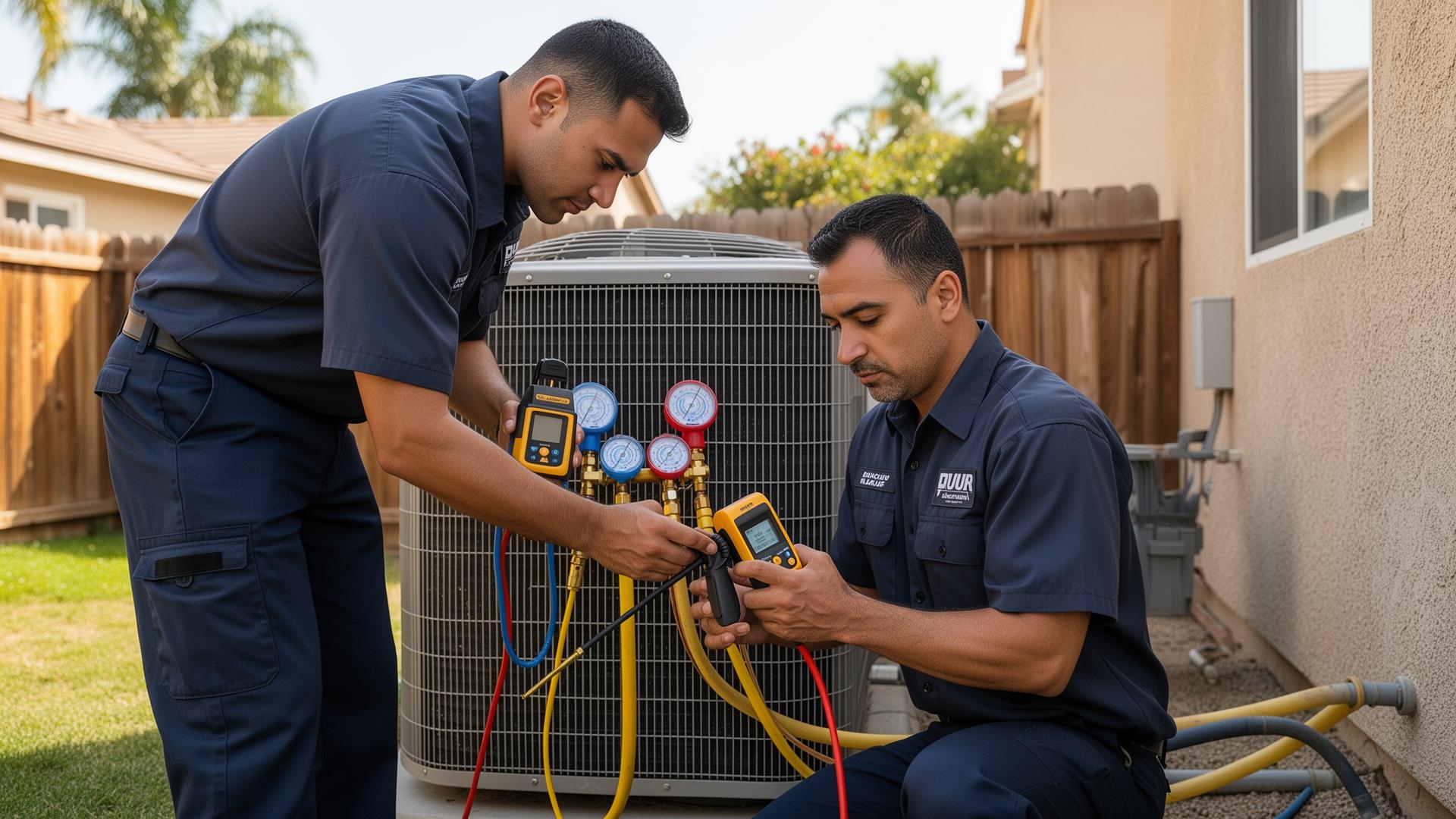
We connect manifold gauges, read suction and head pressure, and calculate superheat and subcooling to confirm low charge before assuming a leak.
Electronic Leak Detection
A calibrated electronic detector sweeps every joint, coil, and fitting. Most leaks are isolated within 30–45 minutes this way.
UV Dye Injection (If Needed)
For slow leaks the electronic probe misses, we inject UV dye, run the system, and return in 3–7 days with a UV lamp to spot the glowing stain.
Repair The Leak
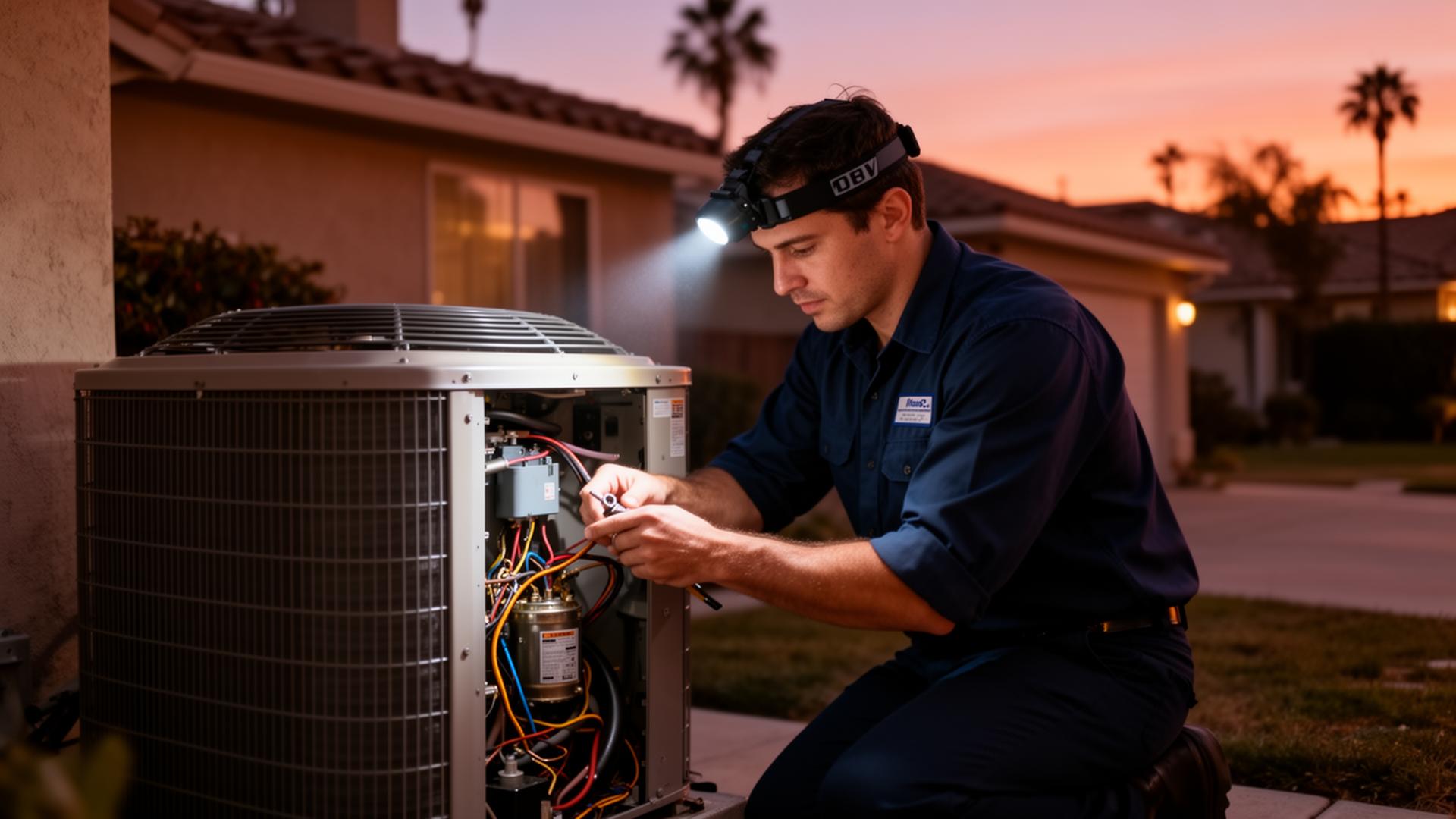
Braze a copper joint, replace a Schrader core, swap a leaking coil, or replace the line set. We quote the repair before any work starts.
Evacuate & Recharge
We pull the system to 500 microns to remove moisture and non-condensables, then weigh in the exact factory refrigerant charge — never 'topped off by gauge'.
Verify & Document
Final superheat/subcooling check, supply temperature reading, and a written invoice with refrigerant type, amount weighed in, and repair warranty.
Inland Empire · Refrigerant Repair
Fix The Leak. Charge It Right.
EPA 608 Certified
Universal-certified techs on every repair, install, and recovery — R-410A, R-32, R-454B handled correctly.
Same-Day Response
When the AC quits in the Inland Empire heat, you don't have hours. Same-day dispatch across both counties.
Flat Pricing
Diagnostic and repair quoted before any work begins. The number on-site is the number on the invoice.
Maintenance Plans
Spring tune-ups, filter swaps, and priority dispatch on annual plans built for desert summers.
View PlansAC Not Cooling
Full no-cool diagnostic — refrigerant is one of six common causes.
AC Repair
Same-day repair for any failed component on any brand.
AC Replacement
When repair stops making sense — especially on aging R-22 systems.
Emergency AC Repair
After-hours dispatch when the house is heating up fast.
Service Area
Riverside County
Cities
Don't see your city? Call (909) 239-6364 — we likely cover your area.
Can you just add freon without finding the leak?
No. EPA Section 608 requires reasonable effort to repair leaks before recharging. Topping off without repair is illegal and just stretches the same problem into another summer of overpaying for refrigerant.
How long does refrigerant leak detection take?
Most leaks are isolated in 30–60 minutes with electronic detection. Slow leaks needing UV dye take a return visit 3–7 days later once the dye has circulated.
How much refrigerant does my AC hold?
Most residential systems hold 5–12 pounds depending on tonnage and line-set length. We weigh in the factory charge — never guess by gauge pressure.
What's the difference between R-410A and R-22?
R-22 was phased out in 2020 — production banned, supply limited, prices high. R-410A operates at higher pressure but is widely available and reasonably priced. R-22 systems still work but parts are getting harder to source.
Should I replace my R-22 system?
Usually yes when the repair quote exceeds 40% of replacement cost. R-22 supply will keep tightening. See AC replacement for honest math.
Is refrigerant dangerous?
Modern refrigerants are non-toxic in normal use, but they displace oxygen in enclosed spaces and the high-pressure liquid form can cause frostbite. Always EPA-certified techs only — never DIY.
Do you handle the new R-454B refrigerant?
Yes. We're trained and equipped for R-454B (the 2025 EPA low-GWP standard) and have the leak detection gear that meets the new mildly-flammable refrigerant safety requirements.
Do you warranty your work?
Every repair carries a workmanship warranty, and we register manufacturer warranties on every install. Most major equipment ships with a 10-year parts warranty when registered within 60 days — we handle that paperwork for you.
What cities in the Inland Empire do you serve?
Every city in Riverside and San Bernardino County — Riverside, San Bernardino, Fontana, Rancho Cucamonga, Ontario, Corona, Moreno Valley, Temecula, Murrieta, Redlands, Hesperia, Victorville, and the Coachella Valley. See the full service-area list at the bottom of this page.
When does it make sense to replace instead of repair?
If the system is 12+ years old, the repair quote is over 40% of replacement cost, or it still runs on R-22 refrigerant, replacement is usually the better long-term call. See AC replacement for honest math both ways.